
Surface water monitoring underpins decisions about water quality, water quantity and regulatory compliance across Western Australia. Whether you manage a mine dewatering discharge, a construction sediment basin, or a local government recreation reserve, the method you use for data collection directly affects how well you understand your environment. Two core approaches exist: grab sampling, where a single water sample is collected at a specific time and location for laboratory analysis, and continuous monitoring, where automated instruments record parameters over long periods at frequent intervals. This article explains the difference and when each approach delivers the most value. Environmental Site Services, based in Western Australia, is a specialist environmental consultancy supporting mining, construction and infrastructure clients with surface water monitoring projects that combine both methods to protect water resources and meet compliance obligations.
Both approaches are used to assess parameters such as dissolved oxygen, pH, turbidity, salinity and water levels across rivers, streams, lakes, dams, drainage channels, ponds, estuaries and mine discharges. Surface water monitoring helps manage scarcity of water resources, and programs aim to protect both surface water and groundwater balance. Key methods focus on combining manual sampling with automated data logging – and choosing the right mix is crucial.
What is grab sampling?
A grab sample is a single, discrete volume of water collected at one point in time and space – for example, a mid-stream sample taken on 12 August 2025 at 10:00 am – then analysed in a NATA-accredited laboratory. Field procedures include using sterilised bottles with appropriate preservatives, completing chain-of-custody forms, and ensuring contamination-free sampling to avoid introducing trace metals into samples. Bailers are commonly used for rapid grab sampling of surface water, while peristaltic pumps suit low-flow shallow water sampling. Low-flow purging is preferred for minimising turbidity during sampling. Common applications in WA include baseline site characterisation, monthly compliance monitoring of discharge points, and incident response after spills or fish deaths. Typical parameters measured include nutrients like TN, TP and ammonia, metals such as arsenic, lead, copper and zinc, hydrocarbons, microbiological indicators, plus field readings of pH, conductivity and water temperature. Critically, each grab sample represents conditions at that moment only – it cannot capture variation over hours or days, which is essential context when evaluating surface water data.
What is continuous monitoring?
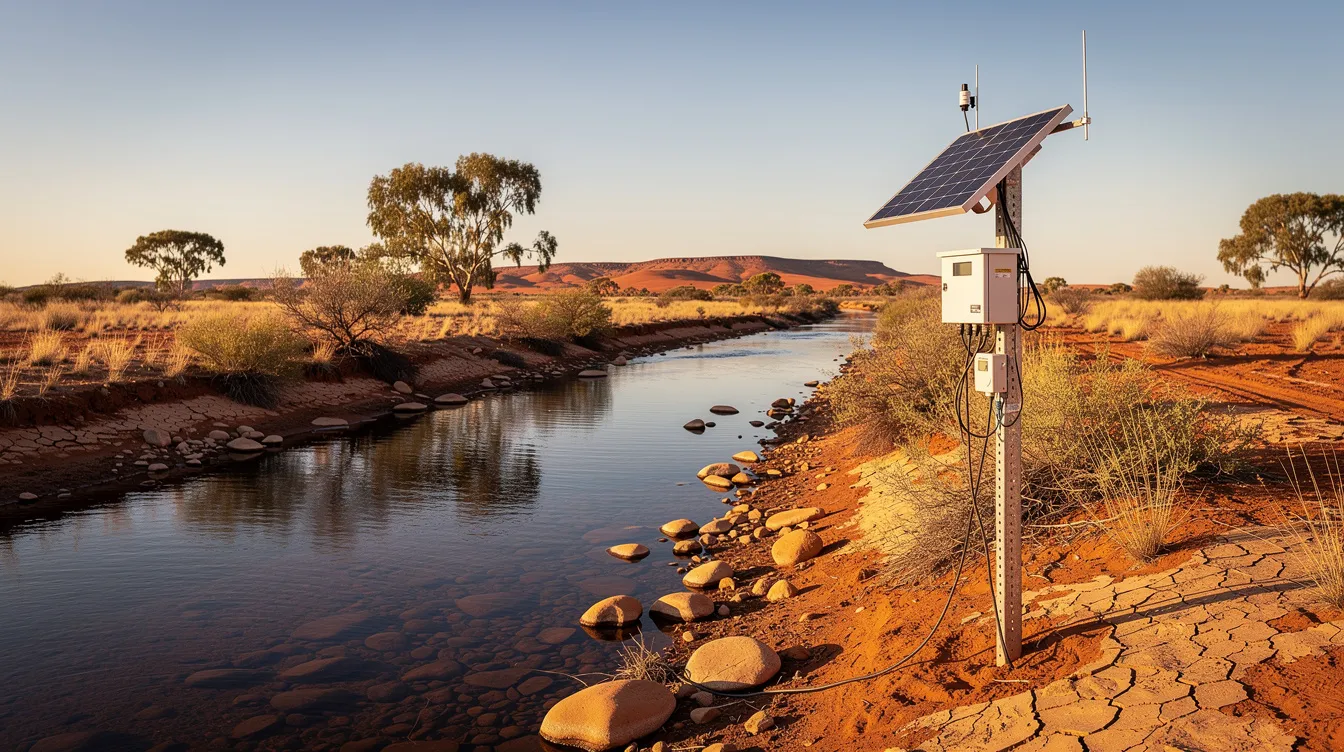
Continuous monitoring uses automated loggers or sondes installed in a river, channel, dam or tank to record water quality and water level data at frequent intervals – typically every 5–15 minutes – over weeks to years. Multiparameter sondes log parameters like temperature and dissolved oxygen simultaneously, while water quality probes measure parameters like pH and turbidity. Automated telemetry enables continuous tracking of water levels and properties, providing real time data for water management decisions. Mobile monitoring stations can operate unattended for long periods, and data buoy systems act as remote monitoring stations for water quality in lakes, reservoirs and wetlands. Automatic water samplers can also collect samples during specific events such as storm runoff. As an example, on a Pilbara mine site drainage channel, continuous logging of turbidity and water levels from December through March tracks first-flush events, peak flow and erosion inputs – dynamics that grab sampling would miss entirely. Surface water monitoring relies on telemetry-based remote sensing techniques to make this feasible even at the most remote sites.
Key differences between grab sampling and continuous monitoring
Both methods answer different but complementary questions, and a monitoring program that combines them often delivers the strongest, most defensible environmental assessment. In terms of temporal resolution, grab sampling provides snapshots while continuous monitoring yields time-series data revealing trends, peaks and variability. Many complex analytes – metals, hydrocarbons, microbiology – still require grab samples and lab analysis, but field parameters like dissolved oxygen, pH, conductivity, turbidity and water level are well suited to continuous instruments. Multiparameter instruments measure critical water quality parameters simultaneously, generating large datasets that demand robust QA/QC and data management. Dissolved oxygen levels are critical for aquatic ecosystems, pH levels affect the chemical behaviour of pollutants in water, conductivity indicates water quality by measuring dissolved ions, turbidity is monitored to assess water clarity, and water temperature impacts aquatic life significantly. Continuous systems can send alarms – for instance, if oxygen drops below a threshold or water levels rise rapidly – supporting flood response, mine water management or protection of downstream ecosystems. Grab sampling is retrospective; it cannot warn in real time but remains essential for regulatory audits. Automated continuous monitoring provides real-time data on various water parameters, while grab sampling delivers the analytical depth that sensors cannot yet match.
Advantages and limitations of grab sampling
Despite advances in sensor technology, grab sampling remains essential for legislative compliance and detailed contaminant analysis. Key advantages include high analytical accuracy from accredited laboratories, a wide range of detectable analytes, established regulatory acceptance aligned with ANZG 2018 water quality guidelines, and lower equipment costs. However, grab sampling can miss short-term events like first-flush turbidity spikes after a storm. In remote WA locations – the Pilbara, Kimberley, Goldfields – site access during the wet season may be physically blocked, adding cost and risk. Lab turnaround of days to weeks delays corrective action. For example, monthly grab sampling of a tailings storage facility seepage collection pond near Kalgoorlie for metals and sulfate provides solid compliance evidence but may miss episodic low-DO or high-turbidity events during rainfall. Environmental Site Services helps clients design sampling frequencies – weekly, monthly or event-based – so that grab sampling still adequately characterises surface water quality.
Advantages and limitations of continuous monitoring
Continuous systems are increasingly expected where operation conditions change rapidly or regulators demand real-time visibility. Advantages include high-resolution datasets, detection of short-lived exceedances, support for predictive modelling, and understanding of diurnal patterns. Continuous monitoring of water levels helps identify flood risks and drought potential, making it invaluable for watershed management. The Run of River salinity survey has been ongoing since 1985, with continuous salinity data collected along 400 river kilometres – demonstrating the long-term power of this approach. Limitations include significant upfront cost for equipment and installation, maintenance to manage fouling and sensor drift, potential data gaps during power failures, and the fact that sensors cannot reliably measure many contaminants such as metals, nutrients at trace levels, or hydrocarbons. Continuous data must be time-stamped accurately with calibration reference points and metadata on sensor maintenance. Environmental Site Services integrates logger data with laboratory results into a single dataset for interpretation, trend analysis and reporting.
Designing a combined monitoring strategy
Most robust monitoring projects use both grab sampling and continuous monitoring. The process starts with defining objectives – compliance, baseline characterisation, impact assessment or early warning – then identifying key receptors such as downstream creeks, wetlands or drinking water supplies. Parameter and instrument selection follows: sondes for field stressors, lab analysis for contaminants. Streamflow estimates are derived from water level data at gauging sites, adding hydraulic context. In WA, regulatory drivers include Ministerial Statements, Part V licences under the Environmental Protection Act 1986, and water licence conditions from the department of Water and Environmental Regulation, whose 2023 guideline outlines best practice. Guidelines also ensure hydrological data is used in urban development planning. As context, over 900 locations are monitored for water quantity and quality in Victoria alone – illustrating the scale at which integrated programs operate nationally. An example integrated program might combine continuous water level and turbidity logging in a creek crossing with monthly grab samples for metals and nutrients upstream and downstream, plus event-based grabs triggered when rainfall exceeds 25 mm in 24 hours.
Applications across Western Australian industries
Mining operations require monitoring of pit dewatering discharge, tailings seepage and creek diversions. Continuous sensors track flow, water levels, salinity and turbidity while grab sampling covers metals, sulphate and nutrients to protect downstream water resources. Monitoring protects rivers, streams and lakes from contamination across these sites.
Civil infrastructure and land development projects generate sediment runoff from subdivisions and roadworks. Short-term continuous turbidity loggers combined with scheduled grab sampling help assess sediment controls – particularly during wet season storm events where efficient response is critical.
Industrial facilities and ports monitor surface water around laydown yards, bulk storage and loading berths. Hydrocarbon or metal-contaminated runoff into coastal and estuarine environments demands both continuous conductivity and DO sensors and periodic grab sampling for detailed analysis of contaminants.
Urban and local government applications include water quality monitoring in constructed lakes, stormwater basins and recreation reserves. Algal blooms impact local economies, especially tourism and recreation, so monitoring nutrients and algae risk alongside dissolved oxygen for fish health is essential. Monitoring provides data to track the health of recreational waterways, and water temperature fluctuations significantly affect aquatic life in these settings. Monitoring is critical for protecting public health and ecosystems across every sector.
How Environmental Site Services can support your surface water monitoring
Environmental Site Services is a B2B environmental consultancy developed to service Western Australia’s most demanding water science projects. Capabilities span surface water monitoring program design, grab sampling campaigns undertaken with NATA-accredited methods, installation and maintenance of continuous monitoring stations including remote solar-powered systems with satellite telemetry, and integration of surface water data for trend analysis and regulatory reporting. These services sit alongside groundwater monitoring, noise and vibration monitoring, occupational hygiene and hazardous materials assessment – so projects with overlapping environmental risks are conducted under one partner. ESS works with land developers, mining companies, construction contractors and asset owners as trusted partners to deliver tailored, efficient solutions that meet both legislative requirements and internal health, safety and environment standards. Water is a precious resource, and the right monitoring approach – whether grab sampling, continuous monitoring or a combined strategy – determines how well you manage it. Contact Environmental Site Services to discuss which approach suits your site and your next mobile water testing or monitoring program. The importance of getting this right cannot be overstated – for your nature of operation, your ecosystem obligations, and your bottom line.