
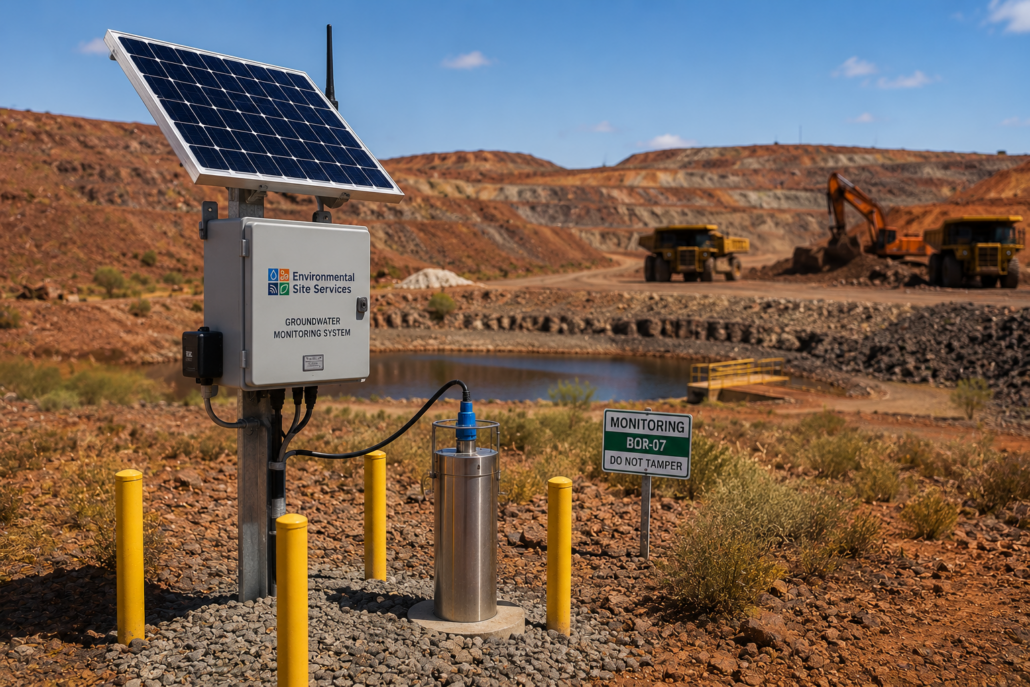
Groundwater is an important source of supply for mining operations, agricultural enterprises, municipal drinking water systems, and industrial facilities. Getting the timing right on when to repeat groundwater monitoring is one of the most common questions environmental managers, compliance officers, and project managers face.
This article covers the key triggers, regulatory requirements, and practical scenarios that determine when repeat monitoring should be undertaken. Whether you manage a mine site, a contaminated land parcel, a construction project, or a water abstraction licence, the guidance below applies directly to your operations.
ENVSS delivers field-first groundwater monitoring services across Western Australia, helping clients collect reliable data that supports compliance and protects groundwater resources over the long term.
Quick Answer: When to Repeat Monitoring Groundwater
The short answer: frequency depends on three things – regulatory requirements, site risk, and operational activity.
Groundwater monitoring supports compliance with licence conditions, and those conditions almost always specify minimum sampling frequencies. But licence conditions are a floor, not a ceiling. Groundwater monitoring tracks aquifer health, water levels, and water quality over time, meaning consistent records are essential for detecting trends and making defensible decisions.
Common triggers that force repeat sampling include:
- Changes to site operations or footprint
- New or increased abstraction from an aquifer
- Construction, dewatering, or major earthworks
- Confirmed or suspected contamination
- Significant groundwater level declines
- Infrastructure failure (bore damage, probe loss)
- Regulatory audit or licence renewal requests
The importance of maintaining consistent groundwater level records cannot be overstated. Without them, you cannot identify whether changes are natural seasonal variation or the result of site activity.
Key Triggers for Repeating Groundwater Monitoring
Not every monitoring event is scheduled months in advance. Many repeat rounds are triggered by specific site events. Here are the most common triggers across mining, construction, and industrial sites.
Site expansion or mine footprint changes. Any change to the physical extent of operations – new pit areas, expanded tailings storage, additional processing infrastructure – may alter groundwater flow paths and drawdown patterns. Repeat monitoring is essential to assess these impacts.
New or increased groundwater abstraction. When a project increases its water use or applies for additional allocation under a licence, updated groundwater data is typically required.
Construction or major earthworks. Dewatering, excavation near the water table, and disturbance of soil layers can change groundwater conditions rapidly. Higher-frequency monitoring during construction helps identify problems early.
Confirmed or suspected contamination. Monitoring helps detect contaminants in soil and water early. Groundwater is vulnerable to contamination from heavy metals and pesticides, and PFAS contamination is a significant concern for groundwater protection across many sites. Once groundwater contamination occurs, it is difficult to remediate, making early detection through repeat sampling critical.
Noticeable groundwater level declines. Declining levels may signal over-extraction, altered recharge, or structural changes in the groundwater system. Early identification of trends allows corrective action before ecological or licencing thresholds are breached.
Equipment failure or bore damage. Damaged monitoring bores, failed loggers, or compromised seals create data gaps. Once infrastructure is repaired, repeat monitoring is needed to re-establish the record.
Regulatory audit requests. Licence renewals, ministerial statement reviews, or compliance audits can require additional monitoring rounds beyond the standard schedule.
Industry-Specific Legislation and Repeating Requirements in Western Australia
Western Australian projects require compliance with the Department of Water and Environmental Regulation (DWER). DWER licence conditions typically specify minimum monitoring frequencies, which may range from continuous water level logging to quarterly or annual water quality sampling depending on the risk profile of the activity.
The Western Australian government provides guidelines for groundwater monitoring practices covering the petroleum, mining, and contaminated sites sectors. Environmental approvals require assessment of groundwater impacts as part of the approval process, and groundwater monitoring data is reported to regulators regularly under licence and approval conditions.
Key regulatory frameworks include:
| Legislation / Framework | Application |
|---|---|
| Rights in Water and Irrigation Act 1914 | Groundwater abstraction licences, operating strategies |
| Mining Act 1978 | Mining proposals, mine closure plans |
| Contaminated Sites Act 2003 | Reporting and managing contaminated groundwater |
| Environmental Protection Act 1986 | Ministerial statements, environmental conditions |
| Petroleum and Geothermal Guidelines 2022 | Onshore petroleum groundwater monitoring |
Outside WA, groundwater monitoring must comply with strict Queensland regulations – for example, projects in central queensland such as the Carmichael Mine operate under detailed groundwater management plans with prescribed monitoring frequencies and reporting obligations.
For any project, the starting point is always to check your project-specific environmental approvals for monitoring frequencies. If you operate under local government or water utility oversight, their site rules may impose additional requirements.
Monitoring Frequency Scenarios for Groundwater Levels and Water Quality
Monitoring frequency is not static. It changes across the lifecycle of a project and in response to events.
Baseline monitoring. Before any ground-disturbing activity begins, baseline data must be collected. This typically involves monthly sampling over several months to capture seasonal rainfall patterns, which produce fluctuations in groundwater levels that need monitoring to establish natural range.
Construction monitoring. During active construction, higher frequency is standard – weekly or fortnightly groundwater level readings, particularly when dewatering or excavation occurs near the water table. Groundwater monitoring helps manage seasonal variations in water levels during this sensitive phase.
Operational monitoring. Long-term compliance monitoring involves assessing groundwater quality and seasonal fluctuations, typically on a quarterly basis. Some operations require more frequent rounds. For example, Bravus Mining monitors groundwater health every two months at the Carmichael Mine.
Event-based monitoring. After heavy rainfall, flooding, chemical spills, or removal of overburden, immediate sampling is needed to detect acute changes in water quality – turbid runoff, chemical leachate, or sediment mobilisation.
Post-incident monitoring. Following confirmed contamination, sampling frequency increases (often monthly) until parameters return below trigger thresholds.
Groundwater Sampling and Water Quality Monitoring: What to Repeat
Each repeat monitoring event should follow the same process to maintain data comparability:
- Repeat low-flow groundwater sampling techniques to avoid disturbing the bore and producing unrepresentative samples
- Repeat field parameter checks – field sampling includes measuring pH, electrical conductivity, and heavy metals where required
- Include repeat sampling for potential contaminants of concern, including arsenic, nutrients, hydrocarbons, e coli, and site-specific analytes
- Repeat depth-targeted sampling across groundwater level gradients to capture vertical variation within the aquifer
Monitoring wells collect groundwater samples for contamination analysis, while groundwater samples are tested against 40 water quality parameters depending on site requirements. Groundwater monitoring helps assess contamination from heavy metals and other chemical compounds by comparing results across repeated rounds.
Quality Monitoring, QA/QC and Data Management
Reliable data requires consistent quality assurance. Every repeat monitoring event should include:
Chain of custody. Implement chain-of-custody documentation for all water samples from the point of collecting samples through transport to laboratory analysis. This ensures data integrity and defensibility.
Accredited laboratories. All analysis must be undertaken by NATA-accredited laboratories with detection limits suitable for the relevant environmental criteria.
Reproducible field methods. Apply the same calibration checks, decontamination procedures, and sampling protocols at every event. Field duplicates, equipment blanks, and trip blanks form part of standard QC.
Continuous monitoring. Telemetry systems enable real-time groundwater monitoring data access, and automated water level logging captures detailed hydrographs illustrating changes in groundwater levels over time. Piezometers measure pore water pressure in the ground, providing data on groundwater pressure conditions within and between aquifers.
Emerging tools. Lysimeters detect contaminants before they enter groundwater systems, acting as an early warning layer. New sensors are being developed to detect PFAS in soil pore water, which may support more efficient screening at affected sites.
Data storage. Store raw data in defensible database formats that enable trend detection, potentiometric surface mapping, and statistical comparison against baseline datasets. Monitoring includes using bore holes to measure standing groundwater levels and fluid pressure, and all records should be retained for the life of the project.
Interpreting Repeat Monitoring Data and Responding to Potential Contaminants
Collecting data is only part of the process. Interpreting it correctly drives informed decisions.
Define trigger thresholds. Water quality exceedances are measured against criteria set in licence conditions, environmental guidelines, or site-specific risk assessments. Thresholds may apply to salinity, heavy metals, nutrients, hydrocarbons, or other contaminants relevant to the site.
Compare against baseline. Every repeat result should be compared against baseline datasets to determine whether observed changes fall within the natural range or indicate an impact from site activity.
Investigate exceedances. When a trigger threshold is exceeded, initiate an investigation. This may involve additional sampling, expanded bore network assessment, or hydrogeological review. Perth relies on numerical groundwater models to understand groundwater flow and recharge, and similar modelling approaches can support investigations at complex sites.
Notify regulators. Report exceedances within the timeframes specified in your licence or approval conditions. Failure to report can result in non-compliance penalties.
Implement responses. Where risks are identified, responses may include source removal, hydraulic containment, modified dewatering, or changes to mining designs. Emerging techniques like InSAR track ground surface elevations caused by aquifer pressure changes, offering supplementary data to support management responses.
Designing a Repeat Monitoring Program for Groundwater Resources and Groundwater Management
A well-designed monitoring program anticipates the need for repeat events rather than reacting after the fact.
Map bores to aquifers and receptors. Geological mapping is necessary to place monitoring bores accurately – for example, in Perth, bore placement reflects the city’s unique hydrogeological setting. Groundwater monitoring programs are tailored to Perth’s unique environmental conditions, including the fact that aquifers supply about 40% of Perth’s drinking water.
Set frequency based on risk. Higher-risk sites (active mining, contaminated land, high-value water resources) warrant more frequent monitoring. Lower-risk sites may justify quarterly or annual rounds.
Assign responsibilities. Field technicians, data managers, and reporting leads should all have clearly defined roles. Observation wells allow continuous groundwater monitoring without sampling, reducing field labour for water level tracking while still generating useful data.
Build escalation pathways. Define what happens when a trigger threshold is exceeded – who is notified, what additional sampling occurs, and what reporting is required.
Budget for long-term monitoring. Monitoring programs must consider environmental impacts on groundwater-dependent ecosystems, and groundwater monitoring prevents over-extraction, protecting interconnected ecosystems. Groundwater monitoring is fundamental for sustainable water management in Perth’s drying climate, where climate change is reducing recharge to key aquifer systems. Budget accordingly for multi-year programs covering both groundwater level and water quality monitoring.
Practical Checklist: When to Schedule Repeat Monitoring
Use this checklist to determine when your next monitoring event should occur:
- After significant rainfall events that may alter groundwater conditions or mobilise contaminants
- After dewatering or abstraction changes that affect the quantity of water drawn from an aquifer
- After any spill, contamination report, or unexpected change to site conditions
- After bore maintenance, drilling works, or replacement of monitoring infrastructure
- At least annually, to review long-term groundwater trends and assess whether current monitoring frequency remains suitable
- Whenever licence conditions or environmental approvals are amended
Case Study Example: Mining Expansion in Western Australia
Consider a mining operation in WA that expands its pit footprint. The expansion alters the local groundwater system by increasing the depth and extent of dewatering. Existing monitoring bores may no longer be representative of conditions at the new pit boundary.
In practice, this trigger requires:
- Installation of additional monitoring bores around the expanded footprint
- Baseline sampling at new bores before expansion activities begin
- Increased monitoring frequency (e.g. monthly) during the transition period
- Comparison of new data against historical records to measure the expansion’s impact on the water level and broader aquifer conditions
A parallel example from Queensland: over 120 monitoring bores were drilled around the Carmichael Mine, and Bravus monitors groundwater health at sites 35km from the mine to track far-field impacts. Groundwater monitoring checks 40 different water quality parameters across these bores, providing the knowledge base for regulatory reporting and ongoing management.
This approach demonstrates how consistent quality monitoring across an expanding bore network supports defensible site assessments and regulatory compliance over time. Regulatory reporting steps include submitting monitoring results to relevant authorities, comparing results against approval conditions, and implementing corrective actions where trends indicate risk.
Next Steps and How ENVSS Can Help with Repeat Monitoring
Knowing when to repeat groundwater monitoring is straightforward once you understand your triggers, your licence conditions, and your site risk profile. Putting that knowledge into practice – with reliable field data, defensible sampling methods, and responsive service – is where ENVSS supports projects across Western Australia.
ENVSS can help you:
- Discuss project-specific monitoring needs and determine appropriate frequencies
- Develop trigger-based groundwater management plans that align with your approvals
- Mobilise experienced field technicians to your site for scheduled or event-based monitoring
If your project requires repeat groundwater monitoring, speak with our environmental specialists to arrange a monitoring program that fits your site, your budget, and your regulatory obligations.