
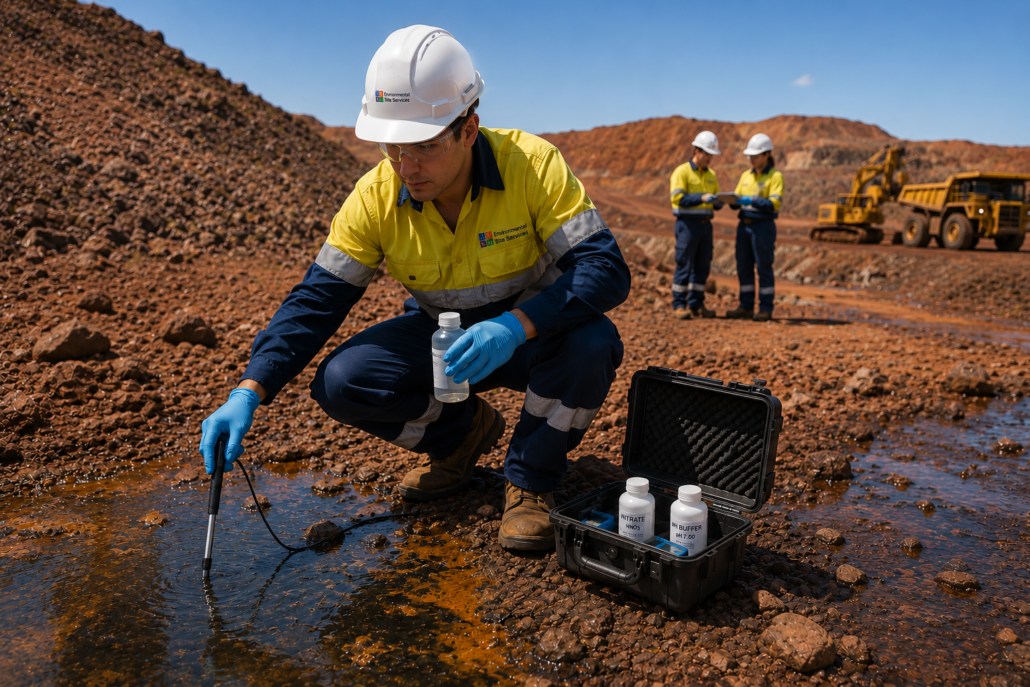
Groundwater contamination rarely announces itself with a single dramatic event. Instead, it tends to develop gradually, which makes it difficult to detect until it’s a larger issue. Knowing what to look for on site can mean the difference between a manageable response and a costly remediation program.
Top early warning signs to look for
Site operators can often spot early warning signs of groundwater contamination well before laboratory results confirm an issue. Routine fieldwork, visual inspections and operational observations all provide practical indicators worth acting on.
Here are the most common signs to watch for:
- Sudden or unexplained changes in groundwater levels in monitoring wells that don’t match rainfall patterns, planned dewatering rates or known abstraction
- Unusual odours from boreholes or sumps – fuel, chemical or sulphur-like smells during purging or sampling
- Discoloured water in dewatering systems, bore holes or sediment basins (this can range from orange-brown, black or milky appearance)
- Corrosion, scaling or salt deposits on well casings, pumps, pipes or other site infrastructure in contact with groundwater
- Fish deaths, fish stock reduction, or vegetation dieback in nearby creeks, farm dams or wetlands
- Complaints from neighbouring bore users about changes in water clarity, yield or taste
- Unexpected changes in groundwater levels between wet and dry seasons on WA mine and construction sites that fall outside the range of prior-year records
- Shifts in field parameters (pH, electrical conductivity, temperature) that deviate from long-term baseline data
Monitoring wells help identify environmental hazards early on, often before contamination reaches off-site receptors. For more detail on how structured monitoring supports these observations, click here.
What is groundwater contamination on a project site?
Groundwater contamination occurs when water beneath the ground surface contains chemicals, metals, hydrocarbons, nutrients or microbes at concentrations above relevant guideline values. In practical terms, it means the aquifer beneath your site is no longer at its natural baseline condition and may pose a risk to health, the environment or operational performance.
On WA mining, industrial and development sites, contamination can affect both groundwater quality and groundwater levels. Contaminants may alter how water moves through the subsurface by changing hydraulic gradients or introducing new recharge sources such as tailings seepage or leaking process water systems.
Common contaminant types relevant to Western Australia include:
- Hydrocarbons – diesel, lubricants, BTEX compounds from fuel storage or petroleum operations
- Metals – nickel, copper, lead, iron and manganese, with naturally elevated background levels in goldfields and nickel belt regions sometimes complicated by tailings or acid drainage
- Nutrients – nitrate, ammonia and phosphorus from wastewater, onsite sewage or agricultural runoff
- PFAS – persistent per- and polyfluoroalkyl substances from firefighting foams at industrial, airport or defence installations
- Saline water – mobilisation of high-TDS groundwater or saltwater intrusion in coastal or palaeochannel aquifers
Groundwater monitoring helps identify contamination from heavy metals and pesticides, among other potential contaminants. Even subtle changes – a gradual increase in salinity, a nitrate concentration rising from 2 to 4 mg/L – can be early indicators of developing contamination. Groundwater accounts for 30% of Australia’s water consumption, making it an important source of water resources that demands careful protection.
Because contamination often moves slowly through soil and rock, early detection through water quality monitoring significantly reduces both remediation costs and compliance risk.
Why early warning signs of groundwater contamination matter
Spotting warning signs early gives site operators the opportunity to respond before contamination reaches off-site receptors, production bores or sensitive ecosystems. Early intervention also provides margin to avoid licence breaches, regulatory enforcement and the reputational damage that follows a reportable contamination event.
In Western Australia, the Department of Water and Environmental Regulation oversees groundwater monitoring in Perth and across the state. DWER imposes licence conditions and environmental approvals under the Environmental Protection Act and Rights in Water and Irrigation Act that frequently require ongoing groundwater monitoring, baseline assessments and incident reporting. Perth relies on groundwater systems for approximately 40% of its drinking water, which underscores why regulators take groundwater protection seriously. Environmental approvals require assessment of groundwater impacts, and groundwater monitoring is essential for regulatory compliance in mining operations statewide.
From a project risk perspective, undetected contamination can affect mine dewatering strategies, increase treatment costs for process water, delay construction programs and damage relationships with neighbouring landholders. Declining groundwater levels are a major challenge due to climate change, adding further pressure on water resources that may already be stressed by mining activities or extraction.
Consider a practical scenario: a WA mine detects rising dissolved copper and nickel concentrations in monitoring wells downgradient of a tailings storage facility. Because the monitoring program captures this trend across two consecutive quarterly sampling rounds, the operator adjusts drainage management and investigates liner integrity before exceeding licence limits – avoiding an enforcement notice and a far more expensive cleanup.
Monitoring wells are critical for mining environmental sustainability. Groundwater monitoring helps mitigate environmental hazards in mining by providing the data needed to react quickly. Consistent monitoring wells data and accurate groundwater level measurements are essential to determine whether observed changes represent normal seasonal variation or an emerging contamination issue.
Common early warning signs in monitoring wells and bore infrastructure
Monitoring wells are usually the first location where subtle changes in groundwater quality and groundwater level can be detected. Monitoring wells provide data on groundwater quality and levels, and provide continuous data on groundwater levels and quality when fitted with suitable instrumentation.
Unexpected changes in groundwater levels. Rapid declines or rises that do not correspond with rainfall, dewatering rates or known abstraction are potential indicators of leakage, new recharge from contaminated sources, or structural issues such as casing breaches. Some monitoring wells are drilled up to 600 metres deep to monitor deeper aquifer systems, and level changes at depth can signal issues that surface observations miss. Monitoring wells provide data on groundwater quality and water table levels that form the basis for trend analysis.
Visual changes in water samples. Increased turbidity, unusual colouration (orange-brown from iron oxidation, black from sulphides, milky or filmy appearance) or a hydrocarbon sheen on the sample surface all warrant investigation. These visual cues are immediate and practical yet often go unrecorded.
Odour indicators. Strong chemical, solvent or fuel smells from purged groundwater, wellheads or sump pits – particularly after rainfall events – indicate new inputs. Sulphidic odours may point to reducing conditions that can mobilise metals.
Field parameter anomalies. Groundwater monitoring measures pH, temperature, and electrical conductivity as standard in-situ parameters. Sudden shifts in these readings, or changes in redox potential and dissolved oxygen, compared to long-term baseline values recorded since installation (e.g. baselines established in 2018–2020) are strong early signals. Water quality sampling identifies acidification and nutrient contamination that may not be visible to the eye.
Infrastructure-related signs. Accelerated corrosion of steel casings, scaling or salt deposits around well heads, fouling of pumps, or frequent clogging of filters and screens often reflect a chemical change in the groundwater – increased dissolved salts, aggressive pH or elevated sulphate concentrations.
Site teams should record and photograph these changes systematically. Consistent documentation supports defensible environmental data, strengthens trend analysis and helps determine whether a change is a one-off anomaly or a developing problem.
Changes in surface water and drainage that may indicate groundwater issues
Groundwater resources are often connected to nearby surface water bodies, drains, wetlands and sumps on typical WA mining and infrastructure projects. Changes at the surface can reflect what is happening in the subsurface.
Visible signs in drainage and pits. Orange iron staining along drain lines, white salt crusts on sediment basin walls, oily sheen on standing water, or persistently cloudy water in pits that receive baseflow from groundwater are all worth investigating. These signs are straightforward to observe during routine inspections.
Ecological indicators. Fish or macroinvertebrate deaths in farm dams or creeks, stressed riparian vegetation, or salt-tolerant species encroaching into previously fresh areas can all point to shifting groundwater quality. Lower groundwater levels threaten local ecosystems and wetlands, and contamination compounds this pressure. Monitoring data helps manage watering schedules for conservation in areas where groundwater supports environmental values.
New seeps or wet patches. Persistent wet areas, seeps or springs appearing in previously dry zones – at the toe of embankments, along access tracks or at the base of slopes – may suggest changes in groundwater level or flow paths driven by construction or dewatering. These seeps can bring potential contamination to the surface.
Rising salinity in operational water. If surface water drawn from dams or sumps for dust suppression or process use shows increasing electrical conductivity or changing ion composition, this can be an indirect warning sign of saline groundwater intrusion or mobilisation from deeper ground.
Regular visual inspections of drainage lines and nearby watercourses should be built into site environmental monitoring programs, supported by photographic records and GPS location data to track changes over time.
Operational and community warning signs around water quality
Operational data and community feedback often provide early warning signs before formal monitoring results flag an issue. These observations deserve the same attention as laboratory data.
Operational indicators:
- Increased frequency of filter changes in water treatment systems
- Scaling in boilers, cooling systems or pipework
- Declining performance of reverse osmosis units using groundwater feed
- Changes in water quantity or pressure from production bores
Staff observations. Workers may notice changes in colour or odour of non-potable site water drawn from bore holes for amenities, washdown or dust suppression. A fuel smell or sulphur-like odour that wasn’t present previously is a strong anecdotal signal that merits investigation.
Community and off-site indicators. Neighbouring property owners reporting changes in bore yield, water clarity, or livestock avoiding traditional watering points can precede regulated limit exceedances. These complaints, when documented and mapped in time and space, often correlate with shifts in groundwater monitoring data.
Documenting and investigating all complaints supports transparent engagement with regulators and helps assess the spatial extent of any developing issue. Environmental managers should establish simple internal reporting pathways so operators, drillers and contractors can flag potential water quality or groundwater level concerns without delay.
How structured groundwater monitoring confirms and tracks issues
While visual and operational warning signs are valuable, structured groundwater monitoring provides the critical data and scientific evidence required to confirm potential contamination and support informed decisions about response actions. Groundwater monitoring involves measuring water levels and quality over time, and is essential for assessing aquifer health and trends across the life of a project.
A typical groundwater monitoring program includes:
- Baseline monitoring – collecting groundwater level and water quality data prior to construction or mining, across multiple seasons, to establish the natural range of conditions
- Network design – installing dedicated monitoring wells screened at relevant depth intervals, including upgradient (background) and downgradient locations, with nested or multilevel systems where vertical gradients need to be understood.
- Field activities – measuring standing groundwater level, purging and sampling monitoring bores, recording in-situ parameters (pH, electrical conductivity, dissolved oxygen, temperature, redox potential), and preserving water samples for laboratory analysis of metals, nutrients, hydrocarbons, pesticides and site-specific contaminants such as PFAS. Water samples are tested against 40 different quality parameters depending on the site’s risk profile and approval conditions
Data is compared against historical records – ideally 3 to 10 year datasets – and guideline criteria to identify statistically significant trends and spatial patterns, rather than reacting to one-off exceedances. Groundwater models predict how aquifers respond to rainfall and extraction, supporting the process of distinguishing natural recharge cycles from anthropogenic signals. Interferometric Synthetic Aperture Radar tracks ground elevation changes that can indicate subsurface water movement or ground settlement related to extraction.
Automated sensors provide continuous monitoring of groundwater levels, collecting critical data at intervals that manual measurements cannot match. This technology is particularly useful on remote sites or where rapid changes in groundwater level need to be tracked in near-real time.
Long-term datasets help distinguish natural variability – for example, the response to 2019–2023 rainfall cycles across WA – from contamination-driven trends. Effective groundwater management requires long-term monitoring strategies that adapt as site conditions evolve.
Robust quality assurance is non-negotiable. Calibrated monitoring equipment, standard operating procedures, accredited laboratory analysis and defensible chain-of-custody documentation ensure data can withstand regulatory scrutiny and support management decisions on site.
Environmental Site Services: practical groundwater monitoring support in Western Australia
Environmental Site Services is a Western Australian consultancy specialising in practical environmental monitoring, with strong field capability in groundwater level and groundwater quality monitoring. The team works across the mining, infrastructure, industrial and development sectors to collect reliable environmental data that supports compliance, operations and long-term environmental management.
Key ways Environmental Site Services assists clients include:
- Designing groundwater monitoring networks with suitable monitoring wells installed at appropriate locations and screened at relevant depth intervals
- Conducting routine sampling programs to monitor water quality across mining, infrastructure, construction and industrial sites throughout WA
- Interpreting monitoring data to identify early warning signs of contamination and support informed decisions about site management
- Developing monitoring programs to meet DWER licence conditions, mining proposals and environmental management plans
The team combines experienced field technicians, modern monitoring equipment and consistent sampling methodologies to collect defensible environmental data. This knowledge and practical field experience ensures data stands up to regulatory scrutiny and provides the evidence needed to protect both the population and the environment that depends on healthy groundwater resources.
To learn more about how structured monitoring can support your project, visit Environmental Site Services – groundwater monitoring.
If you have concerns about potential contamination on your site or need to design, review or expand a groundwater monitoring program, contact Environmental Site Services to discuss your requirements.